
Power outages
Backup power when the grid goes down
Updated November 23, 2026 · Based on manufacturer specs, not hands-on testing
When a power outage knocks out the grid, most households are not trying to run the whole house. They are trying to keep a fridge cold, phones charged, a few lights on, and a modem or router alive so they can get official updates. That job is the same whether the cause is a hurricane, a winter storm, a wildfire shutoff, a tornado, or heat-wave strain on the grid.
Buy direct from BLUETTI
These links go to BLUETTI’s official US pages. They are affiliate links for The Power Porch. Affiliate link: we may earn a commission at no extra cost to you. Full disclosure
-
BLUETTI Apex 300 home backup
Affiliate link: we may earn a commission at no extra cost to you.
-
BLUETTI Apex 200 Expandable Power Station
Affiliate link: we may earn a commission at no extra cost to you.
-
BLUETTI AC200L Portable Power Station
Affiliate link: we may earn a commission at no extra cost to you.
-
BLUETTI Elite 300 Portable Power Station
Affiliate link: we may earn a commission at no extra cost to you.
-
BLUETTI home battery backup collection
Affiliate link: we may earn a commission at no extra cost to you.
Shop these products
Mid-size stations for home backup
Ranked here by official capacity and AC output for household backup, then by stated weight. These are not whole-house generators.
We earn a commission if you buy through our links. As an Amazon Associate we earn from qualifying purchases. “Buy direct from BLUETTI” buttons are affiliate links; we may earn a commission at no extra cost to you. Other brand-site buttons, when shown, are not paid links. Full disclosure
EcoFlow
EcoFlow DELTA 2 Portable Power Station
Shop it from EcoFlow’s official page. Some Amazon listings under this name currently show a different model.
BLUETTI
BLUETTI AC180 Portable Power Station
Affiliate link: we may earn a commission at no extra cost to you.


We order these picks by how well the manufacturer’s specs fit the job on this page — not by commission. Our The Power Porch score is based on manufacturer specs, not hands-on testing, and it isn’t an Amazon star rating. Check the label on your own fridge, CPAP, or other device before you buy, and peek at the maker’s current page in case a number has changed since 2026-11-23.
Different kinds of outages
Hurricanes can leave coastal and inland households without power for days, often with flooding and boil-water notices. Winter storms and ice can do the same in colder states, sometimes for longer, with short daylight for solar recharge. Wildfires and public safety power shutoffs (PSPS) can cut power on a warning, including in otherwise clear weather. Tornadoes may be shorter on the clock but can damage lines and houses at the same time. Heat waves can strain the grid and leave air conditioning and refrigeration as the urgent loads — often beyond what a mid-size portable station can run. Size the station for the loads you can actually cover, then pack water, a radio, and a way to get official alerts for the hazard in your area.
Start with the label on your devices, not a guess
The only reliable watt number for your fridge, CPAP, or window unit is the one on the device itself (and, for many fridges, the yellow Energy Guide label). Starting, or surge, watts can be several times the running watts when a compressor kicks on. If a station’s official continuous AC output is below your running watts, or its official surge rating is below the starting watts, it is not a fit — no matter what a marketing runtime chart says.
A battery’s watt-hour (Wh) rating is a ceiling, not a promise. Inverters and other losses mean you will get less AC energy out than the official Wh figure. Treat “watt-hours ÷ running watts on the label” as a best-case ceiling, then expect a shorter result in real use.
A practical home-outage stack
For a short outage, a mid-size station in the official 1,000–1,200 Wh and 1,500–1,800 W class is the usual fit for a fridge plus phones and lights — if the watts on your devices stay within those ratings. The four picks above all sit in that class, with official weights from about 23.8 lbs (Jackery Explorer 1000 v2 Tech Specs) to about 35.27 lbs (BLUETTI AC180 specifications block). Lighter 256–497 Wh units belong on the apartment and camping guides; they are not sized, on paper, for a household fridge.
If you may be without power for days, plan for a way to recharge: a compatible solar panel within the official solar-input limit, a car charger if you can safely run a vehicle outdoors, or a generator run outdoors only, at least 20 feet from the house with exhaust pointed away from windows, doors and vents (never indoors, in a garage, on a porch or in a carport), per the CPSC, with working CO alarms inside. Gas generators produce carbon monoxide; a portable power station does not, which is why many apartments and HOAs prefer them. See our solar vs gas comparison.
CPAP and medical devices
Check the label and the device manual. Some machines need a pure sine wave AC output (all of the stations in this catalog officially state pure sine wave AC). Some people also use a manufacturer-approved DC cable. We are not medical advisers; if a device keeps someone safe overnight, test the setup on a clear night, well before you need it, and have a backup plan.
Official specifications
The figures below come from the maker’s product page or manual, linked under each item. Our scores use those specs; we don’t do hands-on testing. If a maker’s own pages disagree, we note it.
EcoFlow DELTA 2 Portable Power Station — official specs
| Capacity | 1024 Wh |
|---|---|
| AC output | 1800 W total (surge 2700 W), pure sine wave, 6 AC outlets |
| X-Boost | Up to 2200 W (X-Boost), per the official manual |
| Weight | Approximately 12 kg (27 lbs) |
| Dimensions | 400 x 211 x 281 mm (15.7 x 8.3 x 11.1 in) |
| Battery | LFP (LiFePO4); 3000 cycles to 80%+ capacity |
| Solar input | 11–60 V, 15 A max, 500 W max |
| AC input | X-Stream fast charge 1200 W max |
| Expansion | Official manual: Smart Extra Battery supported (sold separately) |
Sources
- https://www.ecoflow.com/us/delta-2-portable-power-station — Official US product page (1800 W output, up to 500 W solar input, LiFePO4 / 3000+ cycles, expandable storage)
- https://websiteoss.ecoflow.com/cms/upload/2022/9/5/-836145336_1662360821323.pdf — Official EcoFlow DELTA 2 user manual, Specifications section (1024 Wh, 27 lbs, AC 1800 W / surge 2700 W, solar 500 W max, AC input 1200 W max)
No product photo on file yet.
Figures last checked 2026-11-23. We use 1,024 Wh from EcoFlow’s manual (some EcoFlow pages say 1 kWh). Shop it from EcoFlow’s official page — some Amazon listings under this name currently show a different model.
BLUETTI AC180 Portable Power Station — official specs
| Capacity | 1,152 Wh (AC180; the AC180P is a different 1,440 Wh model and is not used here) |
|---|---|
| AC output | 1,800 W constant / 4 x 120 V 15 A outlets, 1,800 W in total; surge 2,700 W |
| Power Lifting Mode | Power Lifting Mode: 2,700 W for high-power heating devices, per official page |
| Weight | About 16 kg / 35.27 lbs (official specifications block) |
| Dimensions | 340 × 247 × 317 mm / 13.39 × 9.72 × 12.48 in |
| Battery | LiFePO4; 3,500+ cycles to 80% original capacity |
| Solar input | 500 W max, VOC 12–60 V DC, 10 A |
| AC input | Turbo mode 1,440 W; Standard mode 1,000 W max |
| UPS switchover | Official user manual: UPS switching time ≤20 ms (test before relying on it) |
Sources
- https://www.bluettipower.com/products/ac180 — Official US product page specifications (1,152 Wh, 1,800 W, 2,700 W surge, 35.27 lbs, 500 W solar, 3,500+ cycles)
Photo: https://m.media-amazon.com/images/I/71Lg8i251IL._AC_SL1500_.jpg, last checked 2026-11-22.
Figures last checked 2026-11-22. We use about 35 lbs from BLUETTI’s specifications block. A marketing line on the same page says 37 lbs.
Jackery Explorer 1000 v2 Portable Power Station — official specs
| Capacity | 1,070 Wh (from Jackery’s tech-specs table: 30.4 Ah / 35.2 V DC) |
|---|---|
| AC output | 1500 W rated, 3000 W surge peak; 3 AC outlets, 120 V 60 Hz |
| Weight | Around 23.8 lbs (10.8 kg) |
| Dimensions | 12.87 × 8.82 × 9.72 in / 32.7 × 22.4 × 24.7 cm |
| Battery | LiFePO4; 4000 cycles to 70%+ capacity |
| Solar input | DC input up to 400 W max (dual port, 16–60 V) |
| Bypass / UPS | Bypass mode AC input/output 100–120 V 60 Hz, 1,500 W (from Jackery’s tech-specs table) |
Sources
- https://www.jackery.com/products/jackery-explorer-1000-v2 — Official US product page Tech Specs table
Photo: https://m.media-amazon.com/images/I/61+aLXXv6eL._AC_SL1500_.jpg, last checked 2026-11-22.
Figures last checked 2026-11-22. We use 1,070 Wh from Jackery’s tech-specs table. Some Jackery pages also say 1,024 Wh.
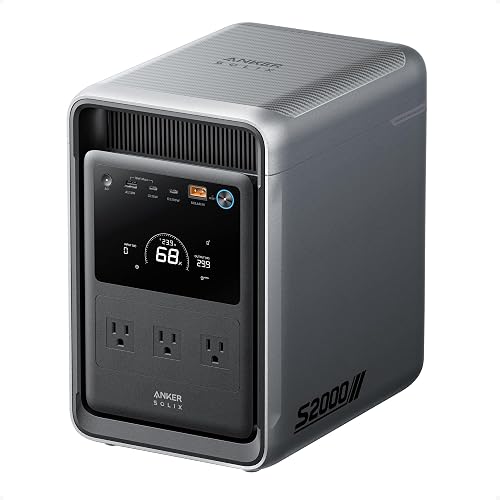
Anker SOLIX C1000 Portable Power Station — official specs
| Capacity | 1056 Wh |
|---|---|
| AC output | 1800 W (SurgePad 2400 W) |
| Weight | 12.9 kg (official US page specs; a pound figure was not stated in that specs block) |
| Dimensions | 376 × 205 × 265 mm / 14.8 × 8.07 × 10.5 in |
| Battery | LFP; official page lists battery cycle 3,000 |
| Solar input | 600 W max |
| AC input | 1300 W charging; 1440 W bypass mode |
| UPS switchover | 20 ms (official US page: UPS switchover time certified at less than 20 ms) |
| Ports | 11 outlets total (USB-A ×2, USB-C ×2, AC ×6, car ×1) per the official US page |
Sources
- https://www.ankersolix.com/c1000-camping-portable-power-station-pps — Official Anker SOLIX US product page
- https://www.amazon.com/dp/B0C5C89QKZ?tag=southernsolar-20 — Amazon listing title verified Nov 23, 2026 (America/Chicago): Anker SOLIX C1000 Portable Power Station with Car Charging Cable, 1,056Wh. A current offer was shown (In Stock). ASIN B0C5C89QKZ.
Photo: https://m.media-amazon.com/images/I/71dwbUWImEL._AC_SL1500_.jpg, last checked 2026-11-23.
Figures last checked 2026-11-23. This is the base C1000 (1,056 Wh), not a solar-panel or bag bundle. The Amazon listing includes the car charging cable, which the official product page already lists in the box.
Also in this catalog
More Amazon listings in this catalog
These additional listings were confirmed on Amazon on Nov 23, 2026 (America/Chicago). We do not show a The Power Porch score until official manufacturer specs are on file.
We earn a commission if you buy through our links. As an Amazon Associate we earn from qualifying purchases. “Buy direct from BLUETTI” buttons are affiliate links; we may earn a commission at no extra cost to you. Other brand-site buttons, when shown, are not paid links. Full disclosure

BLUETTI
BLUETTI Elite 100 mini Portable Power Station
Affiliate link: we may earn a commission at no extra cost to you.



Questions
How big a power station do I need for a power outage?
Add up the running watts on the labels of what you truly need — usually a fridge, phones, lights, and a modem — and confirm the official continuous AC output of the station is above that total. Then use the official watt-hour rating only as an upper bound on how long it might last. Starting watts on a fridge can be much higher than running watts.
Can I run a portable power station indoors?
Portable power stations do not produce carbon monoxide the way a gas generator does, which is why they are commonly used indoors. Follow the maker’s manual for ventilation, temperature, and charging, and keep cables and heat sources in mind. Never run a gas generator indoors or in a garage.
Will these stations run a central air conditioner?
Probably not. Central and many window air conditioners need more starting and running watts than the official 1,500–1,800 W continuous ratings in this mid-size group. Check the watts on your unit’s label. A whole-home backup system is a different product category.