
Buying guide
Best portable power station for a home outage
Updated November 23, 2026 · Based on manufacturer specs, not hands-on testing
“Best” here means the best fit for a typical home outage, based on the manufacturer’s numbers — not a trophy from a test we didn’t run. For most houses, that is a mid-size station with enough output for a fridge compressor, enough watt-hours to ride through a night or a workday, and a weight you can actually move.
Shop these products
Outage picks, by official fit
The first three are mid-size home-backup options. The EcoFlow RIVER 2 is included as a small-load option for phones and lights only.
We earn a commission if you buy through our links. As an Amazon Associate we earn from qualifying purchases. Brand-site buttons, when shown, are not affiliate links. Full disclosure

EcoFlow
EcoFlow DELTA 2 Portable Power Station
Shop it from EcoFlow’s official page. Some Amazon listings under this name currently show a different model.


We order these picks by how well the manufacturer’s specs fit the job on this page — not by commission. Our The Power Porch score is based on manufacturer specs, not hands-on testing, and it isn’t an Amazon star rating. Check the label on your own fridge, CPAP, or other device before you buy, and peek at the maker’s current page in case a number has changed since 2026-11-23.
Four numbers that matter
- AC output (watts). Must clear your running watts, and the official surge rating should clear starting watts.
- Capacity (watt-hours). Sets an upper bound on runtime. More Wh usually means more weight and cost.
- Weight. Official figures in this mid-size group range from about 23.8 lbs to about 35.27 lbs. If you cannot lift it onto a counter, it will not help much.
- Inputs. Official AC recharge wattage, and a solar-input limit if you want to recharge after the grid is down.
Battery chemistry is also worth reading on the official page. The EcoFlow, Jackery, and BLUETTI picks here officially use LiFePO4 (LFP) with cycle-life figures in the thousands. Those figures are the makers’ stated cycle lives, not our measurements.
How we ordered the mid-size picks
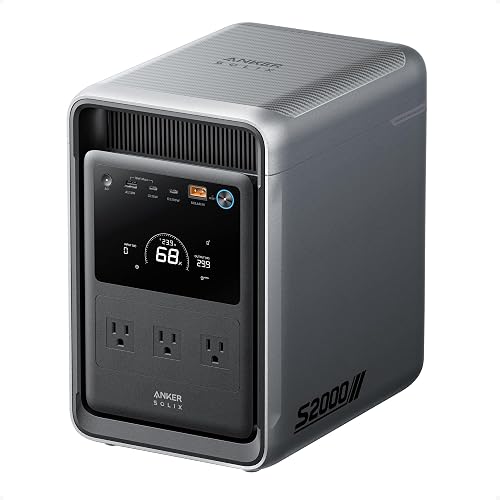
Jackery Explorer 1000 v2 is the lightest mid-size option in this group: 1,070 Wh and 1,500 W at about 23.8 lbs. EcoFlow DELTA 2 steps up to 1,024 Wh and 1,800 W at about 27 lbs, with an extra-battery option. BLUETTI AC180 has the most capacity here (1,152 Wh) and 1,800 W, at about 35 lbs. Anker SOLIX C1000 is in the same neighborhood (1,056 Wh, 1,800 W) and is covered in the backup power and comparison guides.
Official specifications
The figures below come from the maker’s product page or manual, linked under each item. Our scores use those specs; we don’t do hands-on testing. If a maker’s own pages disagree, we note it.
Jackery Explorer 1000 v2 Portable Power Station — official specs
| Capacity | 1,070 Wh (from Jackery’s tech-specs table: 30.4 Ah / 35.2 V DC) |
|---|---|
| AC output | 1500 W rated, 3000 W surge peak; 3 AC outlets, 120 V 60 Hz |
| Weight | Around 23.8 lbs (10.8 kg) |
| Dimensions | 12.87 × 8.82 × 9.72 in / 32.7 × 22.4 × 24.7 cm |
| Battery | LiFePO4; 4000 cycles to 70%+ capacity |
| Solar input | DC input up to 400 W max (dual port, 16–60 V) |
| Bypass / UPS | Bypass mode AC input/output 100–120 V 60 Hz, 1,500 W (from Jackery’s tech-specs table) |
Sources
- https://www.jackery.com/products/jackery-explorer-1000-v2 — Official US product page Tech Specs table
Photo: https://m.media-amazon.com/images/I/61+aLXXv6eL._AC_SL1500_.jpg, last checked 2026-11-22.
Figures last checked 2026-11-22. We use 1,070 Wh from Jackery’s tech-specs table. Some Jackery pages also say 1,024 Wh.
EcoFlow DELTA 2 Portable Power Station — official specs
| Capacity | 1024 Wh |
|---|---|
| AC output | 1800 W total (surge 2700 W), pure sine wave, 6 AC outlets |
| X-Boost | Up to 2200 W (X-Boost), per the official manual |
| Weight | Approximately 12 kg (27 lbs) |
| Dimensions | 400 x 211 x 281 mm (15.7 x 8.3 x 11.1 in) |
| Battery | LFP (LiFePO4); 3000 cycles to 80%+ capacity |
| Solar input | 11–60 V, 15 A max, 500 W max |
| AC input | X-Stream fast charge 1200 W max |
| Expansion | Official manual: Smart Extra Battery supported (sold separately) |
Sources
- https://www.ecoflow.com/us/delta-2-portable-power-station — Official US product page (1800 W output, up to 500 W solar input, LiFePO4 / 3000+ cycles, expandable storage)
- https://websiteoss.ecoflow.com/cms/upload/2022/9/5/-836145336_1662360821323.pdf — Official EcoFlow DELTA 2 user manual, Specifications section (1024 Wh, 27 lbs, AC 1800 W / surge 2700 W, solar 500 W max, AC input 1200 W max)
No product photo on file yet.
Figures last checked 2026-11-23. We use 1,024 Wh from EcoFlow’s manual (some EcoFlow pages say 1 kWh). Shop it from EcoFlow’s official page — some Amazon listings under this name currently show a different model.
BLUETTI AC180 Portable Power Station — official specs
| Capacity | 1,152 Wh (AC180; the AC180P is a different 1,440 Wh model and is not used here) |
|---|---|
| AC output | 1,800 W constant / 4 x 120 V 15 A outlets, 1,800 W in total; surge 2,700 W |
| Power Lifting Mode | Power Lifting Mode: 2,700 W for high-power heating devices, per official page |
| Weight | About 16 kg / 35.27 lbs (official specifications block) |
| Dimensions | 340 × 247 × 317 mm / 13.39 × 9.72 × 12.48 in |
| Battery | LiFePO4; 3,500+ cycles to 80% original capacity |
| Solar input | 500 W max, VOC 12–60 V DC, 10 A |
| AC input | Turbo mode 1,440 W; Standard mode 1,000 W max |
| UPS switchover | Official user manual: UPS switching time ≤20 ms (test before relying on it) |
Sources
- https://www.bluettipower.com/products/ac180 — Official US product page specifications (1,152 Wh, 1,800 W, 2,700 W surge, 35.27 lbs, 500 W solar, 3,500+ cycles)
Photo: https://m.media-amazon.com/images/I/71Lg8i251IL._AC_SL1500_.jpg, last checked 2026-11-22.
Figures last checked 2026-11-22. We use about 35 lbs from BLUETTI’s specifications block. A marketing line on the same page says 37 lbs.
EcoFlow RIVER 2 Portable Power Station — official specs
| Capacity | 256 Wh |
|---|---|
| AC output | 300 W total (surge 600 W), pure sine wave |
| X-Boost | X-Boost up to 600 W, per the official US product page footnotes |
| Weight | 7.7 lbs (official US product page; footnote 6 says this weight is for RIVER 2 only) |
| Battery | LFP / LiFePO4; official page: 3000+ cycles |
| Solar input | Compatible with 110 W solar panel (official comparison chart) |
| Ports | 6 output ports (official comparison chart) |
Sources
- https://www.ecoflow.com/us/river-2-portable-power-station — Official US product page (256 Wh, 300 W output, X-Boost up to 600 W, 7.7 lbs, LiFePO4, 3000+ cycles, 6 ports)
Photo: https://m.media-amazon.com/images/I/51awsbDJNgL._AC_SL1500_.jpg, last checked 2026-11-22.
Figures last checked 2026-11-22. This is the 256 Wh RIVER 2, not the Max, Pro, or RIVER 2 (240).
Also in this catalog
More Amazon listings in this catalog
These additional listings were confirmed on Amazon on Nov 23, 2026 (America/Chicago). We do not show a The Power Porch score until official manufacturer specs are on file.
We earn a commission if you buy through our links. As an Amazon Associate we earn from qualifying purchases. Full disclosure



Questions
Is a 300 W station enough for a home outage?
It can keep phones, lights, and a modem going if those watts fit. It is not a match, on output, for most household refrigerators. The EcoFlow RIVER 2 officially lists 300 W continuous AC; the mid-size picks officially list 1,500–1,800 W.
Do I need solar panels with the station?
Not for a short outage if you can charge from the wall before the storm. Official solar input matters if you may be off-grid for days. Buy a panel within the official voltage and watt limits on the station’s own page.
What does LiFePO4 mean on a product page?
It is a battery chemistry (lithium iron phosphate, also called LFP). Makers often publish a cycle-life figure with it. Those figures come from the manufacturer, under stated conditions, and are not tests by this site.